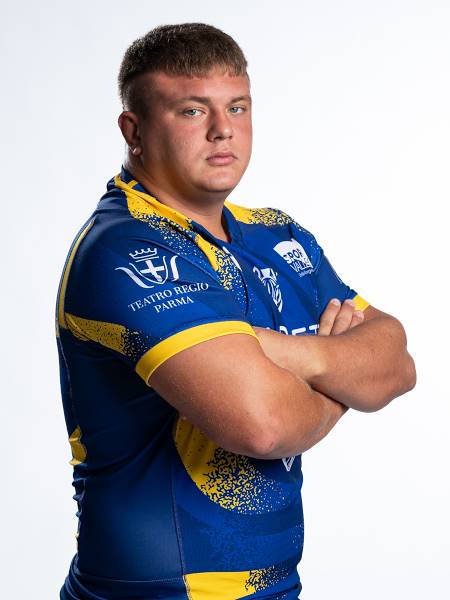
In a sport that prizes collisions, endurance and relentless work at the breakdown, few positions demand more complete commitment than flanker. For Zebre Rugby, Ion Neculai embodies many of those qualities, bringing imposing physical dimensions and the rugged profile of a forward built for the uncompromising demands of top-level rugby. At 189 centimetres and 132 kilograms, Neculai stands out immediately as a player capable of imposing himself in contact, but his value to Zebre goes beyond sheer size. In the modern game, where back-row forwards must combine mobility, physicality and tactical discipline, Neculai represents the kind of presence every side needs to compete in the tight exchanges that often decide matches.
Neculai operates in one of rugby’s most influential positions. The flanker’s role is broad and unforgiving: carrying hard into heavy traffic, stopping opposition momentum with dominant tackles, contesting possession at the breakdown and offering support in both structured and broken play. It is a position that often reveals a player’s appetite for work as much as his technical quality. For Zebre Rugby, a club that has long had to fight for every edge against deep and experienced opposition, a flanker with Neculai’s frame and forward-oriented skill set offers a valuable platform around which phases can be built.
Physically, Neculai has the profile of a player designed for confrontation. At 132 kilograms, he brings unusual mass for a flanker, a trait that can be particularly useful in slowing opposition ball, winning collisions and adding ballast to defensive sets around the ruck. Yet size alone is never enough in elite rugby. The challenge for any forward of that build is to translate power into repeatable effectiveness across 80 minutes, and that is where flankers earn their reputations. The best among them are not simply big men; they are tireless workers who repeatedly arrive at the right place at the right time. Neculai’s role with Zebre is shaped by that expectation.
His presence in the back row gives Zebre a different kind of edge. In possession, a player of his dimensions can be used to punch holes close to the breakdown, generate quick metres after contact and force defensive systems to condense around him. That in turn can create wider opportunities for teammates. In defensive phases, a heavy, aggressive flanker can alter the rhythm of an opponent’s attack by making dominant tackles and disrupting continuity. Teams at the professional level are always searching for forwards who can win the gain-line battle, and Neculai’s physical tools make him naturally suited to that contest.
The modern flanker, however, must be more than a carrier and tackler. Rugby has evolved into a game of constant movement, and back-row forwards are increasingly judged by their ability to contribute across multiple phases without a drop in intensity. They are expected to be first to the breakdown, effective in transition defence, reliable in support lines and disciplined in their decision-making. For a player such as Neculai, that means balancing his obvious power with the mobility and positional awareness required at this level. Zebre’s system depends on forwards who can absorb pressure but also keep the team connected, and the flanker’s role is central to that balance.
Neculai’s value also lies in the tone he can help set. Every rugby side needs players who bring a confrontational edge, particularly in the forward pack, where momentum is established and protected. A flanker often serves as the side’s emotional barometer, tasked with lifting intensity when the match becomes attritional. Zebre Rugby, competing in a demanding environment, benefits from players capable of matching opponents physically and refusing to yield easy metres or quick possession. Neculai’s profile suggests a player well suited to those battles, the sort of forward who can make his mark in the less glamorous but essential exchanges that shape results.
There is also an important tactical dimension to his role. In today’s game, the breakdown remains one of the sport’s defining battlegrounds. A flanker who can arrive quickly, stay strong over the ball or clear effectively in support of teammates can influence territory, tempo and possession. Even when not producing the headline moment, a back-row player can have a profound impact through the accumulation of small wins: slowing a recycle, forcing an extra pass, making a low tackle that prevents offload momentum, or carrying just far enough to keep a sequence alive. Players in Neculai’s position are often judged best by how much easier they make the game for those around them.
For Zebre, squad construction is always about finding players who can compete physically while maintaining enough versatility to meet the demands of high-level competition. Neculai fits the mould of a forward who can help anchor that effort. At 189 centimetres, he has the reach and frame to be effective in close-quarter exchanges, while his weight underlines his potential as a force in contact. Those are not superficial measurements in rugby; they are indicators of how a player can be deployed and what sort of tactical burden he can carry for his side.
Career narratives in rugby are often built on consistency rather than spectacle, and that is especially true for forwards. The most respected flankers are not always the most visible names on a team sheet, but they are frequently the ones coaches trust most in difficult moments. Neculai’s ongoing task at Zebre is to turn his physical assets into sustained influence: to be reliable at the breakdown, forceful in defence and productive as a ball carrier. If he can continue to do that, he strengthens not only his own standing but also Zebre’s capacity to compete through the middle of the field, where so many matches are won and lost.
In an era when rugby increasingly rewards players who can combine old-fashioned toughness with modern mobility, Ion Neculai remains an intriguing figure in Zebre Rugby’s pack. His size makes him impossible to ignore, but it is his ability to channel that power into the demanding craft of back-row play that defines his importance. For Zebre, he is the kind of flanker who offers substance, steel and a platform for the side’s broader ambitions. And in professional rugby, those qualities remain as valuable as ever.