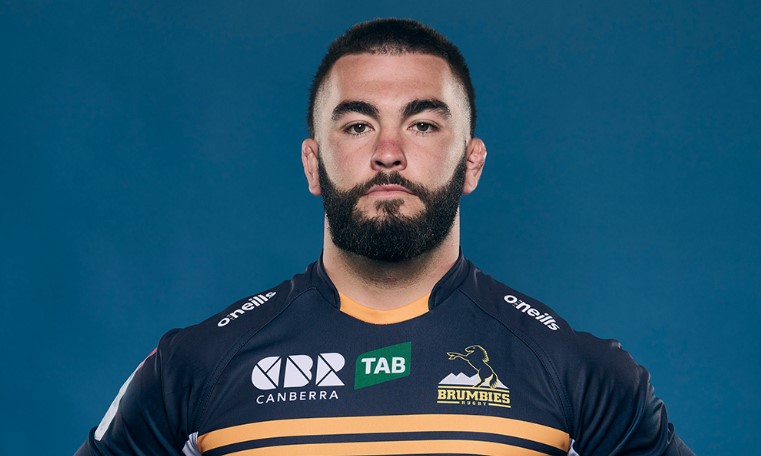
Luke Reimer has built his reputation the hard way, through work rate, accuracy and a constant presence where matches are most often decided: around the breakdown and in the collisions that shape territory, momentum and belief. For the Brumbies, the flanker represents the kind of forward every successful side needs — durable, industrious and tactically sharp enough to influence a contest without demanding the spotlight.
At 187cm and 102kg, Reimer brings the physical profile expected of a modern back-row forward, but his value goes well beyond measurements. In a game that increasingly asks flankers to be hybrid athletes — part tackler, part link player, part jackal threat and part defensive organiser — Reimer fits the brief with impressive consistency. He is not simply a carrier or a cleaner; he is a player whose all-action style gives the Brumbies balance across the park.
That balance matters. The Brumbies have long prided themselves on structure, discipline and forward efficiency, and the flanker role within that system is especially demanding. It requires a player who can move seamlessly from set-piece support to open-field defence, from slowing opposition ball to providing quick ruck service for his own side’s attacking shape. Reimer’s game is built for that responsibility. His engine allows him to stay involved deep into matches, while his reading of play helps him arrive early at key contests rather than simply reacting after the damage has been done.
The first thing that stands out in Reimer’s profile is his appetite for work. The best flankers often make themselves indispensable not through one spectacular moment, but through dozens of small, high-value actions: a tackle that stops momentum, a cleanout that secures fast ball, a chase line that forces a hurried kick, a support run that keeps an attack alive. Reimer has the sort of game that coaches trust because it is repeatable. He does the difficult, unglamorous jobs that allow the Brumbies’ more expansive players to operate on the front foot.
Defensively, he offers the kind of presence every forward pack relies upon. His size gives him the ability to meet carriers squarely and absorb heavy traffic, but his effectiveness comes from more than strength alone. Reimer’s defensive contribution is tied to timing, body position and effort after contact. He is capable of stopping runners behind the gain line, and just as importantly, he can recover quickly enough to contest the next phase. In modern rugby, where attacking teams look to create stress through tempo and repeated phase play, that ability to reset and stay accurate is invaluable.
Then there is the breakdown, the specialist territory where elite flankers can alter an entire match. Reimer’s role here is central to the Brumbies’ competitiveness. A strong breakdown forward must know when to attack the ball, when to prioritise the tackle, and when to fold into the defensive line rather than overcommit. Reimer’s game suggests a player with that judgment. He applies pressure without recklessness, and that distinction is important. Winning turnovers is valuable, but so is forcing slower possession, making scrum-halves hesitate and disrupting attacking rhythm. Even when he does not claim the ball outright, a flanker who creates uncertainty at the ruck can be just as influential.
In possession, Reimer’s contribution reflects the evolution of the back row. The old stereotype of a flanker as a pure defensive specialist no longer applies at the top level. Teams need forwards who can carry with purpose, connect phases and maintain continuity. Reimer’s frame allows him to be effective in contact, particularly in tight channels where leg drive and body control matter most. But his usefulness with ball in hand is also about decision-making. A good back-rower understands when to straighten the line, when to present quickly and when to act as a support option rather than the focal point. Those details are often what keep attacking sequences alive.

His physical dimensions underline why he is suited to the demands of the position. At 187cm, he has the reach and lineout-adjacent utility expected of a modern loose forward, while 102kg gives him enough mass to compete in heavy exchanges without sacrificing mobility. That combination is significant in a competition where flankers are routinely asked to defend in wide channels one minute and hit central rucks the next. Reimer’s build supports a style based on repeated involvements rather than selective appearances.
Within the Brumbies setup, that reliability is a major asset. Every strong side needs players who can absorb tactical complexity and still execute the basics under pressure. Reimer’s role may not always be the most glamorous, but it is one of the most essential. He helps set the defensive edge, contributes to the team’s contest at the breakdown and provides the connective tissue between the tight five and the backs. In practical terms, that means he is often involved at the exact points where matches swing: the first defensive set after a turnover, the ruck after a line break, the phase that either sustains pressure or surrenders it.
Professional rugby increasingly rewards adaptability, and Reimer appears well equipped for that reality. Opponents vary in how they stress a back row. Some sides test mobility by moving the ball quickly to width; others challenge physical resilience through direct carriers and repeated pick-and-go pressure. Reimer’s profile suggests a player capable of meeting both demands. He has the frame to handle attritional rugby and the movement to stay relevant when the game opens up.
That blend of industry and rugby intelligence is what gives his career trajectory substance. Not every important player is a headline-maker, but every successful team has a core of performers whose standards shape the collective. Reimer fits that category for the Brumbies. He is the kind of flanker who raises a side’s floor and, on his best days, its ceiling as well. His current value lies in consistency, but consistency at this level is not ordinary; it is one of the hardest qualities to maintain.

As the demands on loose forwards continue to grow, Luke Reimer remains a compelling example of the modern flanker: physical without being one-dimensional, diligent without being limited, and influential in the areas that define winning rugby. For the Brumbies, that makes him more than a squad contributor. It makes him a foundational presence in the contest, the sort of player whose impact is felt in every phase, every chase and every battle for possession.