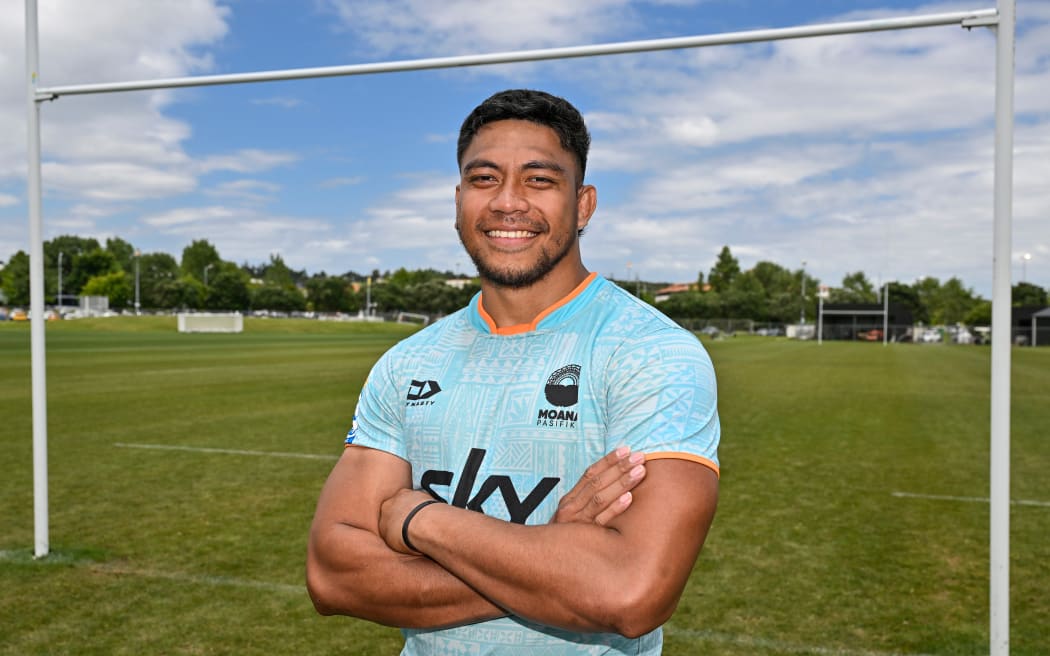
Miracle Faiilagi is building a reputation as one of the most physically imposing and increasingly influential forwards in Moana Pasifika’s pack, a flanker whose size, mobility and work rate make him a significant figure in the modern back-row game. In a competition that demands relentless intensity from loose forwards, Faiilagi brings a blend of power and athleticism that gives Moana Pasifika both ballast and edge around the contest.
At 192 centimetres and 118 kilograms, Faiilagi possesses the kind of frame that immediately stands out, even in a sport populated by elite athletes. Those measurements tell part of the story: he has the size to carry hard into contact, the strength to absorb heavy collisions, and the physical presence to contribute meaningfully in defensive exchanges close to the gain line. But the role of a flanker at professional level is about far more than raw dimensions. It is a position defined by effort, timing, decision-making and repeat involvements, and those are the areas in which Faiilagi’s value to Moana Pasifika becomes most apparent.
For a side that has worked to establish itself through resilience, identity and forward momentum, flankers are central to setting the tone. They are expected to clean out rucks, pressure opposition ball, support carriers, make tackles in volume and offer themselves as options in transition. Faiilagi’s profile fits those demands. He is the sort of back-row forward who can help generate momentum through direct carrying, while also contributing to the less glamorous but essential work that underpins a competitive pack performance.
Moana Pasifika’s rugby identity has often been associated with physicality, ambition with ball in hand and a willingness to challenge opponents through direct confrontation. In that environment, Faiilagi’s strengths are well suited. His size gives him immediate impact as a carrier, particularly in tight channels where post-contact metres and body position can be crucial. A flanker of his build can force defensive adjustments simply by demanding multiple tacklers, and that in turn can create opportunities elsewhere for support runners and wider attacking shapes.
Just as important is his defensive role. Modern flankers must be able to close space quickly, make dominant tackles and recover in time to influence the next phase. Faiilagi’s physical tools suggest a player capable of imposing himself in those moments. At his best, a flanker of his profile can slow opposition momentum not only through tackle completion but through the force of contact, preventing clean ball and making life harder for attacking teams attempting to build rhythm.
There is also strategic value in having a back-rower with genuine mass. Against larger forward packs, Faiilagi offers parity and resistance. Against quicker, more mobile opponents, he can provide a different kind of challenge: a carrier and defender who brings heavyweight intensity to repeated involvements. Coaches increasingly value forwards who can combine specialist breakdown duties with line-speed, carrying threat and defensive reliability, and Faiilagi’s role sits squarely within that framework.
While jersey information is not listed here, his positional identity as a flanker is enough to frame the expectations around his game. Whether operating on the blindside or openside, the fundamentals remain demanding. A blindside flanker often brings lineout support, physical edge and close-quarter carrying. An openside flanker is more closely associated with speed to the breakdown and turnover pressure. Many modern players are asked to blur those distinctions, and the best back-row units are built on flexibility. Faiilagi’s size points naturally toward the abrasive elements of the role, but in today’s game, effectiveness comes from marrying power with mobility and discipline.
That makes his development particularly interesting within the Moana Pasifika setup. The franchise has placed a premium on players who can contribute to a hard-working, emotionally committed style of rugby, and Faiilagi appears to fit that mould. Loose forwards are often judged not only by highlight moments but by accumulation: the extra cleanout, the tackle made after retreating, the carry taken under pressure, the support line run that keeps an attack alive. Those details shape matches over 80 minutes, and they are often where a flanker earns the trust of coaches and teammates.
Physically, Faiilagi already has the attributes to compete in demanding professional environments. The challenge for any back-row forward is to translate those gifts into week-to-week influence. Consistency is the mark of established top-level flankers. It is one thing to produce isolated moments of force; it is another to repeatedly affect the speed and direction of a game. For Moana Pasifika, having a player with Faiilagi’s dimensions and positional responsibilities offers the possibility of exactly that kind of sustained impact.
His presence also matters in a broader squad-building sense. Teams need balance in the back row: ball carriers, tacklers, lineout contributors and breakdown workers. A flanker who can bring physical intimidation while remaining active around the field adds tactical flexibility. He can complement a more specialist scavenger, support a No. 8 in carrying exchanges, or help absorb the attritional demands of set-piece-to-set-piece rugby. In long campaigns, those qualities are invaluable.
The modern game places enormous pressure on defensive transitions and ruck speed, and that is where flankers often define themselves. A well-timed cleanout can preserve attacking continuity. A tackle behind the gain line can derail a phase pattern. A powerful carry can reset field position and inject life into a team under pressure. Faiilagi’s role is tied to those moments, the decisive passages that rarely dominate headlines but regularly determine outcomes.
As his career continues with Moana Pasifika, Faiilagi stands out as a player whose profile matches the demands of elite rugby’s most unforgiving positions. At 192cm and 118kg, he has the physical base to be a force in collisions, but his significance lies in how those tools can be applied across the full spectrum of flanker duties. For Moana Pasifika, that means a forward capable of bringing edge, substance and momentum to the contest.
In a team still shaping its place and identity at the highest level, players like Miracle Faiilagi are essential. He represents the kind of back-row presence every side needs: powerful, hard-working and equipped for the sport’s most demanding exchanges. If he continues to grow into the role, Moana Pasifika will have in him not just a contributor, but a forward capable of setting the standard in the trenches where matches are won.