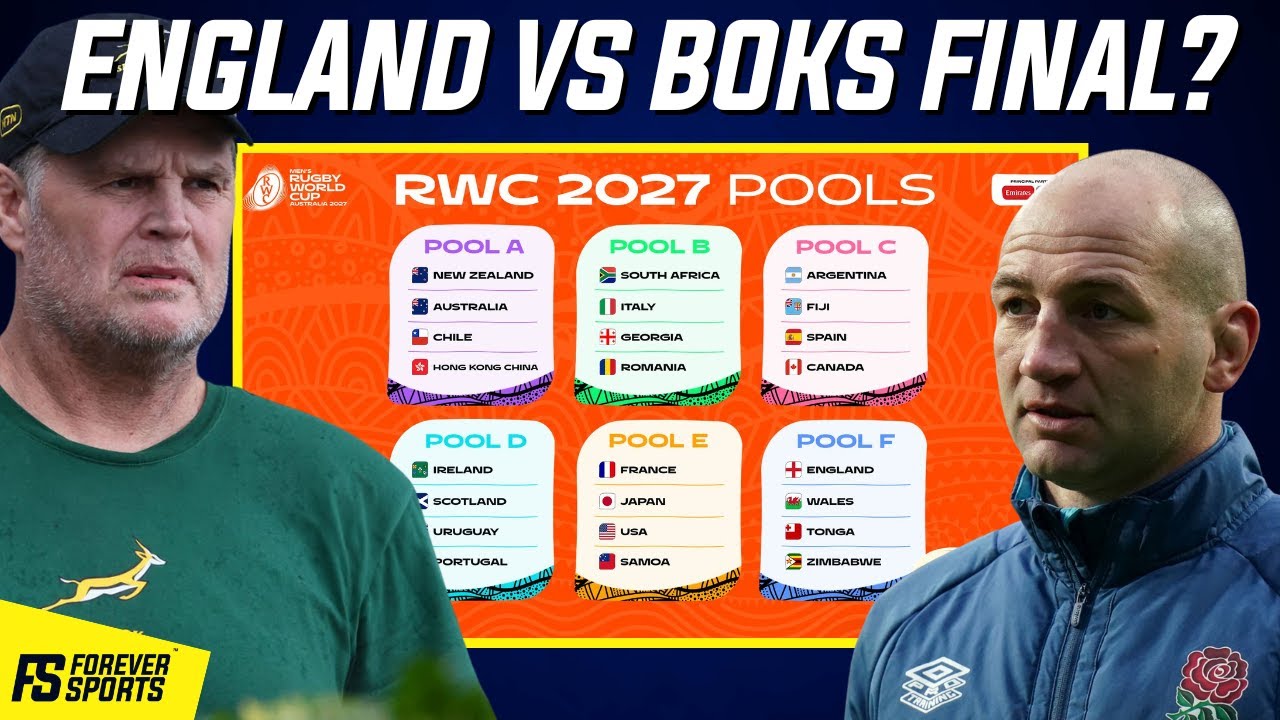
The Rugby World Cup 2027 draw is finalised, the new round-of-16 format is locked in, and the early simulations are exposing the part of the redesign nobody at World Rugby wants to talk about. According to Forever Sport's run-through, if every team finishes its pool exactly where the world rankings predict, the All Blacks and Springboks meet in the quarterfinals. France, ranked fifth, would survive on the easier side of the draw. The final would not feature world rugby's two best sides.
"If you're New Zealand or South Africa, you're probably not particularly happy with the draw," the host said. "Because at this stage, those two sides are set to meet in the quarterfinal stage and the potential winners to potentially meet France."
The simulation method is straightforward. With six pools of four — pools A through F — the host assumed each pool finishes in world-ranking order, and that the four best third-placed sides advance to the round of 16 alongside the top two from each group.

Using that logic, his round of 16 produced these matches: New Zealand v Georgia, South Africa v Spain, Fiji v Wales, France v Scotland, Australia v Japan, England v Italy, Argentina v Tonga, Ireland v USA.
"Your big matches Fiji Wales over there, France Scotland and Australia Japan probably potentially won," he said. "But in general, there's also some pretty one-sided affairs."
The trouble starts when those round-of-16 winners line up for the quarterfinals. Played out as a straight ranking, the bracket gives world number one against world number two in the last eight, plus a separate clash between the fifth and eighth-ranked sides.
"That's where people are sort of having an issue with the system," the host said. "You've now only got New Zealand versus South Africa. That is your number one ranked side against your number two ranked side. Then you've got Fiji versus France. France are ranked fifth and Fiji down in eighth."

Apply ranking again and South Africa go through. France beat Fiji. England roll Australia. Ireland edge Argentina.
"Then those are your semi-finals," he said. "You then have South Africa versus France, England versus Ireland."
By the time the simulation reaches the last four, the world's second-ranked side has already been eliminated and the fifth-ranked side is two wins from a final.
"Already by the semi-final stage, your second ranked side when this draw was taken is not going to feature," he said. "And your fifth ranked side is going to feature."

The simulated final lands South Africa against England — a one-versus-three pairing the host concedes is defensible.
"In theory you'll go sit there saying, 'well, that's the right decision,'" he said. "My biggest problem is there probably should have been seedings, because South Africa, New Zealand being the number one and number two should be on either sides of the draw. After that kind of becomes a bit more fair game."
That criticism is the consistent thread through the early format reaction. The expanded 24-team field is supposed to grow the tournament without compromising its integrity, but the absence of strict bracket seeding means that two of the world's strongest sides can be funnelled together long before they should be.
The host was careful not to oversell his own model — pool finishes will not match world rankings precisely, and a couple of upsets reshape everything. But the bottom line, he argued, is that there are simply not enough plausible upsets to redraw the bracket far enough.
"The only groups which might not end up like this are maybe Scotland really come up and Ireland struggle, maybe Fiji beat Argentina," he said. "But I don't think there's that many spaces for potential upset, which means the simulation is pretty close on what I think we probably will see."
For New Zealand and South Africa fans, the upshot is uncomfortable. The All Blacks face a Springboks side that has won back-to-back World Cups in a quarterfinal that, in any sensibly seeded draw, would be the last match of the tournament. For France, ranked fifth, the route to the final is genuinely kind. The 2027 home tournament has finally given Australia a draw that does not feature the All Blacks until the latter stages — and even then, only if the Wallabies climb out of the same half as England.