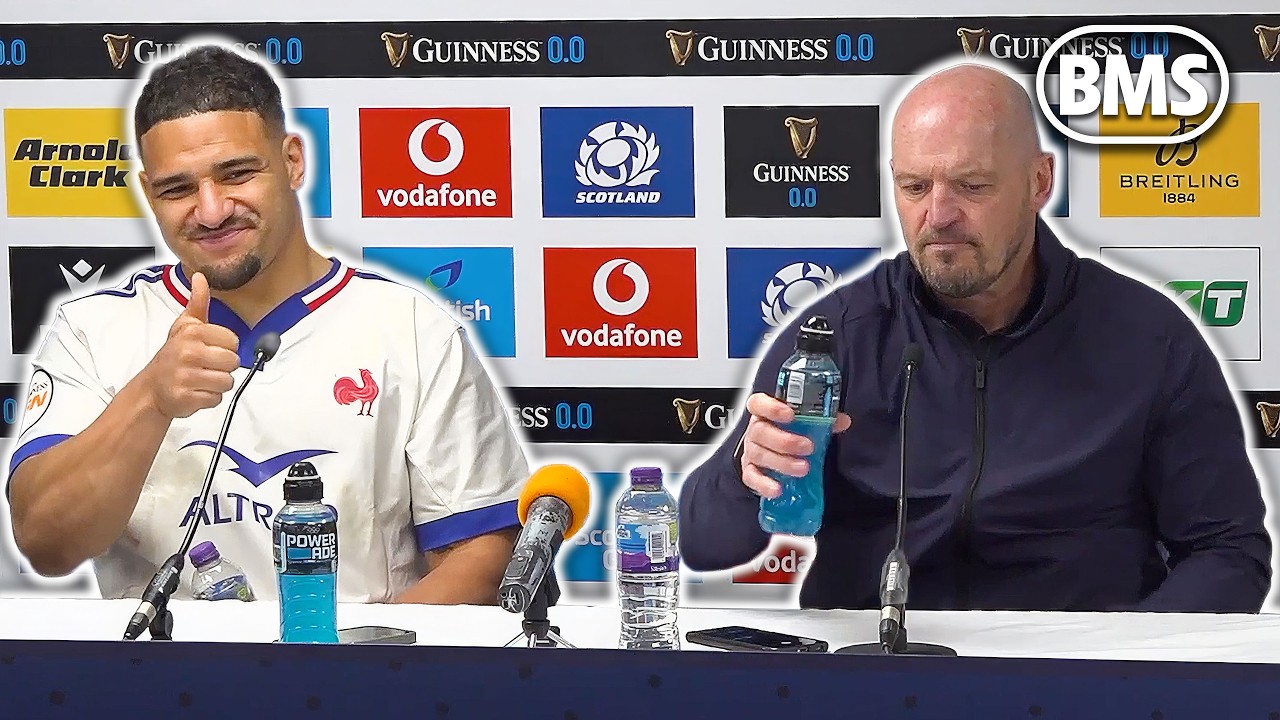
Scotland did not just beat France in Edinburgh. They unpicked them. By the time Gregor Townsend's side had run their fourth-round Six Nations opponents off the park 50-40, captain Sione Tuipulotu was sitting in the post-match press room making one of the boldest claims of his Test career: that Scotland's midfield is, on its day, the best in Europe — and that France's wasn't better than his.
"I can't remember the last time I got to a rugby game and thought they were better — 10, 12, 13 — playing than me, Finn, and Huw," Tuipulotu said, referring to Finn Russell at fly-half and Huw Jones at 13. "And that's just my mentality. It doesn't always go our way. But that's my mentality when I go to a rugby game — I don't think other players are better than Finn, or other players are better than Huw. That's just my mentality when I get to the game. I'm proud of the way those two played today."
It was not arrogance. It was, as Tuipulotu framed it, the only way to walk into Murrayfield against a French midfield containing Bordeaux's Matïeu Jalibert and Yoram Moefana, with Antoine Dupont pulling the strings from nine. "I knew the middle of the field is a really strong part of their team," Tuipulotu said. "You've got the Bordeaux contingent of Jalibert, who's been playing some of the best rugby in the world, Moefana, who's been a good centre for years for them. They've got their chemistry with Dupont." The captain was clear-eyed about the threat. He was also unwilling to accept it.
Tuipulotu's leadership theme — restated several times in his press conference — was that the result was almost secondary. "Today was more about us being us, and probably less about us winning or losing the game," he said. "That was my challenge to the group yesterday when I spoke in the changing room before the captain's run — let's relieve up the pressure of winning or losing this game. Let's just go out and be us. I felt like that was enough for us to win this game, and it proved to be. We were ourselves out there. We were aggressive with our play calling. We had penalties — we didn't take threes. We went to the corner and we pressed the issue."
That aggression yielded six tries in 80 of the most chaotic Test minutes the championship has produced. Scotland led in chunks, were pegged back, then re-broke the game open. Asked how the team kept its composure through the swing of momentum, Tuipulotu credited fly-half Russell. "I feel safe with him inside me — he can tackle anything. Cheers, bro." The line, delivered with the wry smile that has become a Tuipulotu trademark, sums up the trust at the core of the Scottish backline.
The captain was equally generous about the pack. "I really want to credit the pack. The effort that went into that game from a pack perspective — the way that French forward pack had been rolling those first three weeks of the championship going back to the autumn — the work our forward pack had to do today is probably part of that as well. They got to the breakdown over and over and over again against a high-tackling team. They carried well. We won our set piece. The scrum was good in the first half. We drew penalties from them. I just want to credit the pack on the penalty count."
Townsend, asked to put the result in context, refused to call it Scotland's greatest day in a thistle. "I'll let you guys decide that," he said. "It was a very good day. But it's round four of the tournament — it's not a stand-alone game. There've been other games where it's probably meant a lot to the group, because of what — whether it was a response, or we hadn't broken a record winning away from home in Paris, or Wales, or beating England for the first time for a number of years. So maybe ones that have more significance. This is very significant. But just now it's round four, and it gives us a chance to be in round five."
The coach also drew a line between this performance and recent painful Scotland nights — pointing at the Argentina autumn defeat as a reference point. "The Argentina experience was a painful one," Townsend said. "The changes we had to make in the group were more about the mindset and dealing with momentum swings. That was a big focus. Cardiff was a great opportunity — and the week before, against England, we were ahead and kept the momentum going. Cardiff was evidence to the players of what we believe and what they're believing — that we can handle those momentum swings."
Asked about the score itself — six tries for, six conceded — Townsend admitted it had surprised him. "I thought it was a six," he said when the journalist mentioned seven tries scored. "Oh, OK, seven was it? Yeah. Yeah, sorry. Someone was telling me it was three tries in the first half, three tries in the second half. But I forgot we scored another one as well." The smile told the rest. Scotland's coach had been so consumed by the moment-by-moment chess match that the scoreline had become a footnote.
The team's next assignment, Townsend conceded, is the heaviest possible. "Probably the most difficult challenge for us — maybe any other Six Nations team over the last five to 10 years — going to Dublin and getting a victory. We know we'll have to build that win and play as well as we did today to get the win." Tuipulotu, in the room next door, was not ducking it either. "We've got one more job to do." Edinburgh, for one weekend, had been all theirs. The next test would write the longer story.