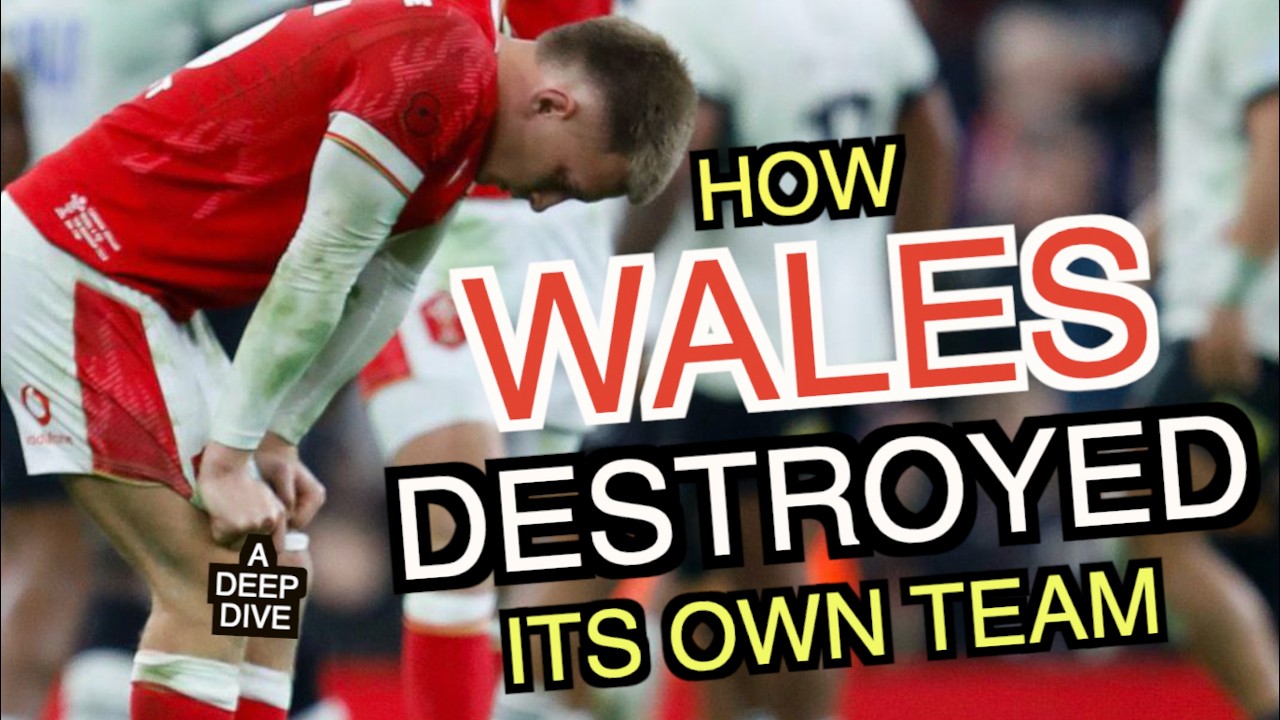
Wales men's rugby has gone 25 losses in their last 28 Tests since the 2023 Rugby World Cup. In February 2026 they posted the smallest Six Nations crowd in Principality Stadium history. A new long-form investigation from analyst Squidge Rugby argues that none of this is an accident — and that the Welsh Rugby Union itself is the architect of the collapse.
The 34-minute deep dive, released to roughly 72,000 viewers this month, cuts past the traditional coach-of-the-week discussion and instead reconstructs a decade-and-a-half of institutional decisions that stripped Wales of the developmental system that built its golden generation.
The starting point is the 2008-2012 academy programme that produced Alun Wyn Jones, Sam Warburton, Leigh Halfpenny, George North, Taulupe Faletau, Jonathan Davies, Justin Tipuric and Dan Biggar. Squidge describes the structure in detail: four regional academies, a specialist WRU-level oversight group, senior team coaches such as Neil Jenkins working one-on-one with 15-year-olds, and individualised plans for any young player of national significance.
That system, according to Squidge's reporting, was 45% funded by a European Union grant. The funding ended in 2012, reapplication became impossible after the 2016 Brexit vote, and the WRU chose to cut rather than replace.
In Squidge's account, the restructured academy selected only 27 players across the nation for group sessions. Josh Adams, Tomos Williams, Wyn Jones and Cory Hill — future British & Irish Lions and senior internationals — were not among them. The reduced programme ran for two years before being cut entirely, with player development offloaded to the four professional regions themselves. Total funding for age-grade and academy work, he estimates, fell by roughly 80% within four years. In that same window, Ireland tripled theirs.
The financial story worsened during the pandemic. Where the Irish government donated €8 million to Irish rugby, and the RFU and SRU negotiated government-backed loans at modest interest rates, Squidge notes that the WRU took out a commercial NatWest facility with a reported rate north of 8% — four times what Premiership clubs were paying on their Covid support. The four Welsh regions were then saddled with the repayments, forcing the Ospreys in 2023 to move on every squad player over 30 bar captain Justin Tipuric, including 14 internationals and four Lions in a single transfer window.
The direct knock-on for player development is one of the documentary's most striking passages. Squidge argues that Dan Biggar graduated into a Welsh system whose senior squad averaged 29 years of age; his Ospreys successor Dan Edwards graduated into one averaging 24. Experienced players who once mentored the next generation — Marty Holah with Tipuric, Ben Blair with Halfpenny, Regan King with Jonathan Davies — were no longer affordable.
The comparison Squidge makes between Ospreys back-row Morgan Morse and Saracens and England star Henry Pollock is blunt. Both were born four days apart, both he argues have similar natural ability, but Pollock has five times as many caps, one Lions jersey and the backing of a Northampton academy he says carries roughly twice the Ospreys' budget plus a £1.4 million annual RFU grant.
Even the internal spending priorities raise questions. Squidge points to disclosures by current WRU CEO Abi Tierney that the union was spending around £50,000 a year on flowers alone — the cost of an additional academy coach. He also notes that in the same week in November 2025 that Wales suffered their heaviest-ever home loss to South Africa, the WRU executive awarded itself a 35% pay rise. Chair Richard Collier-Keywood then told the media the union had no money.
Senior coaching culture comes under equal scrutiny. Squidge cites Dragons prop Dillon Lewis describing his move to Harlequins, where national coaches ran weekly check-ins and one-on-one sessions with up-and-coming players — something he said never happened under Warren Gatland or Wayne Pivac in Wales. The new Steve Tandy regime, he notes, has started to put coaches in regional training on a weekly basis, but concedes the fix arrives late for at least one generation.
The documentary's sharpest line comes from former Grenoble and Pau performance analyst Andrew Jones, whose published piece Squidge quotes approvingly: "The difference between Wales and France is not talent, it is exposure." Squidge contrasts uncapped Welsh centre Eddie James — 20 professional games before his Test debut — with his opposite number Émilien Gailleton, who at the same age had racked up more than 100 professional appearances across Pro D2, Top 14 and international age-grade.
Squidge ends by noting that the WRU has committed £40 million over the next five years to academy, grassroots and coach-developer work — a genuine uplift that would still leave Wales spending half of what Ireland currently do, not a quarter. He is cautious. His concern is that the union is simultaneously pushing forward proposals to reduce the number of Welsh professional regions, which he argues would choke the very pathway the funding is meant to reopen.
Steve Tandy's 2026 Six Nations, for all its losses, showed tangible signs of improvement. But the documentary's core argument is that no coach, however good, can replace 15 years of compounded decisions. For Wales to come back, Squidge suggests, the WRU has to stop being the main obstacle to it.