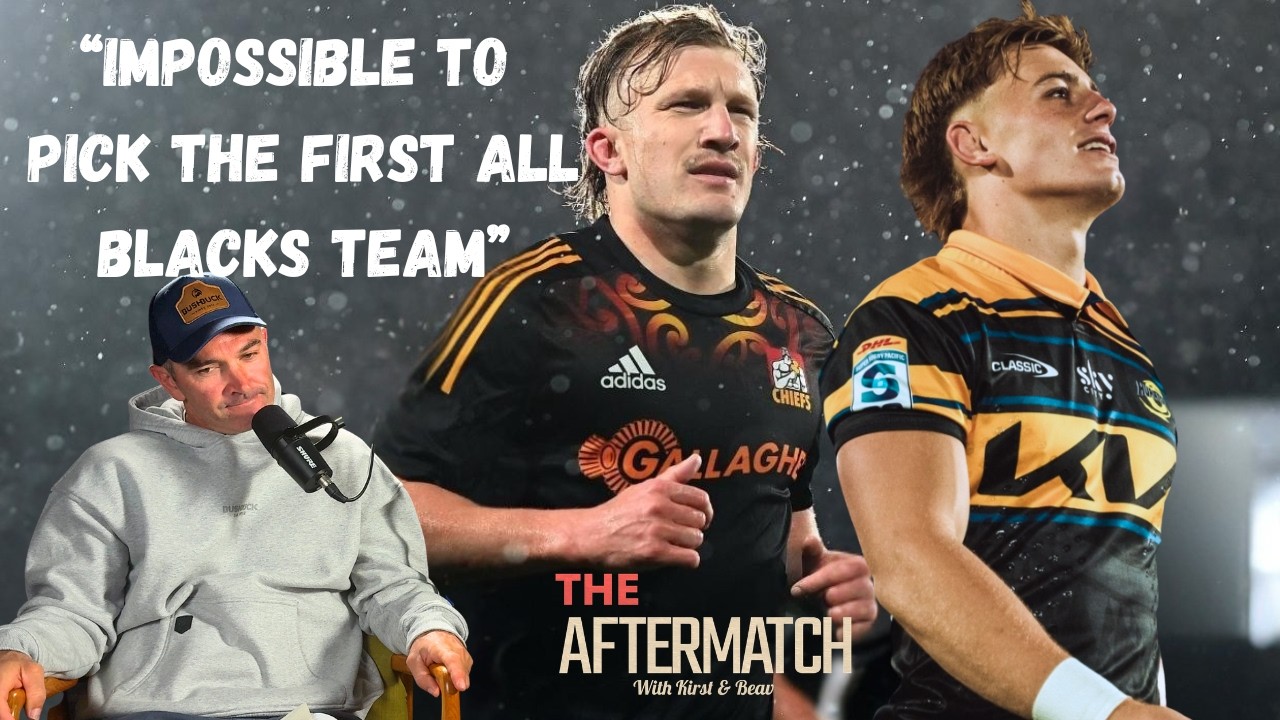
The Aftermatch podcast with Steve "Beav" Beaver and Kirsty Crawford-Bevin used a viewer question this week to break down what Dave Rennie will actually be looking for when he names his first All Blacks squad next month. The question, from a viewer named Sarah, asked why none of the contenders has been able to nail down the No. 10 jersey. Beav's answer cut straight to the differentiator he believes will settle the contest.
"Whoever becomes the best game manager out of all of them, I would think that becomes your All Blacks first five," Beav said. "Because if you just picture them up as pure rugby players and skills, they are all very similar."
Beav grouped the current crop into two tiers. Damian McKenzie and Ruben Love are the two NZ-based playmakers he singled out by name, with Richie Mo'unga the "outlier that's going to come back into the fold" if the eligibility conversation around overseas-based players resolves in his favour. "From a physical, athletic point of view, they're all great off the mark, they've all got speed, they're all fit as hell, they are all great in the back field," Beav said. "When they kick the ball, they end up at 15, ball comes back to them, they can ignite counterattacks." On the raw athletic profile, in other words, there is nothing to choose between them.
So what does game management actually mean once it leaves the cliche pile? Beav defined it as the No. 10 owning the direction of the team from the set piece outward. "When you go to a line out or a scrum, the first five dictates what happens next," he said. "He dictates whether you throw the ball out to your wing and you have a crack at them out wide with ball in hand. He dictates whether you do a close target and you do a box kick. He dictates everything like that. So that's essentially game management."
The harder part, Beav added, is reading phase play in real time and knowing when to abandon a sequence. "In phase play, you've maybe evolved and you're going through the phases, it's up to him to decide, hey, we're going nowhere and if we continue, we're only going to get ourselves in trouble — turn over, they get the ball, they get a penalty back down our part of town. Or no, I've decided enough's enough, I'm going to kick to a corner or I'm going to put one up in the air."
Pressed on who has historically set the bar, Beav named Dan Carter as the complete package, alongside Jonny Wilkinson, Stephen Larkham and, going further back, Grant Fox. "I mean, all the all the big names — the Wilkinsons and Larkhams and all the rest of it," Beav said. "Foxy, you know, we were obviously young, but he had a wonderful pack that he just dictated the terms to as well. So yeah, the guys who reached the top are the best in that regard."
Co-host Kirsty steered the conversation to a stat one viewer, posting as Rugby Analyst, had flagged: under Rassie Erasmus's brief run of consulting, the All Blacks scored just two tries from turnover ball in the 2025 Rugby Championship — last in the competition, with Argentina on five, Australia on six and South Africa on 13. Beav read it as a function of attitude rather than personnel. "If you want to go back in time and look at that Rugby Championship this year, what was the All Blacks' attitude towards counterattack? I don't think it's too big a stretch to say I thought we were probably conservative on the attitude towards that."
The kicking game, he argued, is the entry point. Box kicks short on the 22 won't generate counter-attack chances; longer, wider kicks force a single back-three player into a decision they will usually take as a kick back. "If you can get into a wider channel and kick from a wider channel, you're going to be able to kick longer," Beav said. "Then you're going to get one guy back there who invariably isn't going to feel confident about counter-attacking himself. So, what's he going to do? He's going to kick it back to you. And all of a sudden you're going to get kicks that aren't off structured situations, which frees up the counter-attack."
If Rennie wants those kicks to come from a No. 10 who can also call them off on the run, Beav's framing is clear: the contender who controls the next month of Super Rugby — not the one who looks sharpest in patches — gets the jersey.