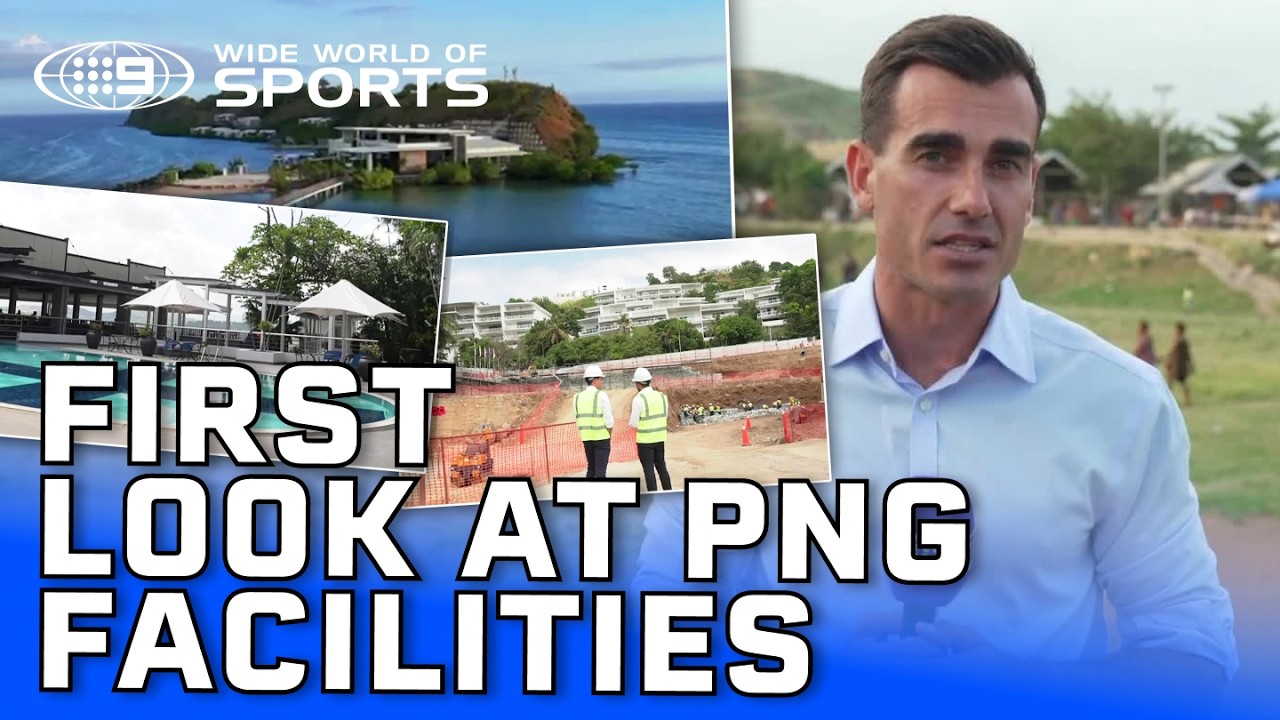
The most pointed answer in the PNG Chiefs' rolling charm offensive this week did not come from a player or a politician. It came from a coach's wife who had just stepped off three flights from the United Kingdom and was being walked through the Airways Hotel by club CEO Lorna McPherson.
Kira Peters, wife of inaugural head coach Willie Peters, was given a first look at the expansion franchise's Port Moresby base by Nine News, met PNG Prime Minister James Marape, and used the visit to push back on what she described as out-of-proportion fears about safety in one of the world's most-watched cities for crime statistics.
"What a lovely man. He's got such beautiful energy. He's a good person," Kira Peters said of the prime minister.
Asked directly about the move, she did not flinch.
"It would be amazing," she said. "For everyone, I think it's — you can make such a difference to a country."
The tour itself was deliberately staged. The Airways Hotel base, which the club is using as its initial home, includes pool, day spa, hair salon, tennis court, gym, restaurants and a playground. Players and families will also have access to the private Malolo Island Resort, with what was described to the visitors as a private beach. Still under construction is a 67-apartment, purpose-built residential village set to house 300 Chiefs officials by November next year, complete with retail, a large 7-Eleven and a medical centre.
"We're creating a village and it's a whole-of-life aspect," McPherson explained on the walk-through. "It's a lot more green, a lot more open space than I guess the other facilities around Port Moresby. We're also having a retail, a large-scale 7-Eleven and a medical centre as well."
The PR exercise sat uneasily against the broader reality. Port Moresby remains one of the most dangerous cities in the world by most international measures, with consistently high levels of street crime and ongoing tribal tensions. Diplomatic and corporate expats based there typically work under tight security protocols.
Kira Peters, who is no stranger to the city — she has previously lived there with her family — said that did not match her own experience.
"I think security is always something that we always need to make sure that we take precautions with," she said. "But, you know, do I worry about what I do as a person and an individual? No. Would I bring children? My kids came here, went to school. They went in the school bus in the morning and they came home in the school bus, without any security. So I think it's blown out of proportion."
Asked specifically whether she was worried about her own safety, her husband's, or her children's, the answer was equally direct.
"Not at all," she said. "Just coming off the plane this morning, I felt safe in Port Moresby."
The Chiefs, who enter the NRL ahead of the 2028 season, have built much of their public messaging around exactly that argument: that the lived experience of expats and locals inside a controlled environment is markedly different from the perception many Australian-based players' families have absorbed from a distance. The signing of established Rabbitohs forward Jeremiah Nanai (and previously announced marquee Alex Johnston) has been used as evidence the model is workable for current first-graders, not just journeymen.
Whether the message lands with the WAGs and partners who will ultimately decide whether players are willing to base their families in Port Moresby remains to be seen. The Chiefs' strategy, plainly, is to keep producing days like this one — high-profile tours, prime ministerial handshakes, and quotes from inside the village — until the safety conversation shifts.
For now, the Chiefs have their first lady on board, on the record, and on message.