Stormers attack coach Dawie Snyman has lifted the curtain on the playing philosophy that has the Cape Town side topping the United Rugby Championship and reshaping the way South African club rugby attacks, with captain Ruhan Nel adding the sevens-bred discipline that underpins how the Stormers' midfield reads the game.
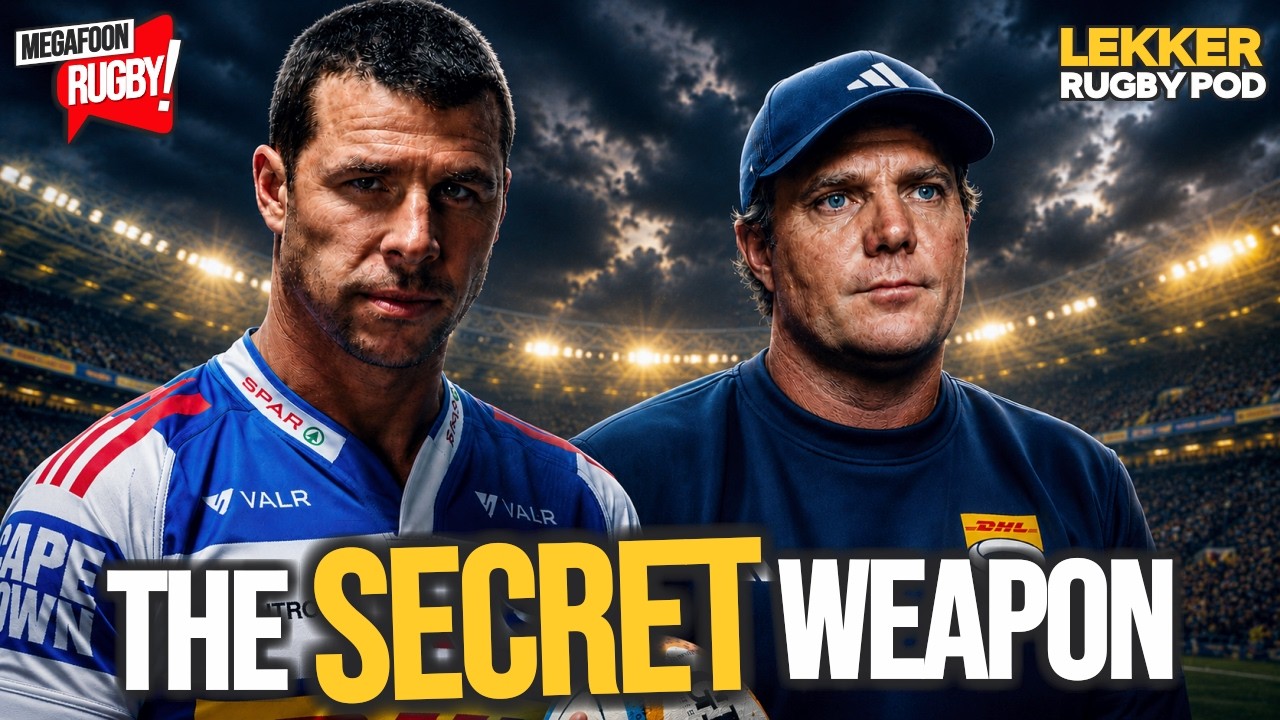
Speaking on the Lekker Rugby Pod on Megafoon Rugby, Snyman was unusually candid about how much of the Stormers' attacking shape is left to the players, in particular fly-half Sasha Feinberg-Mngomezulu and centre Damian Willemse. The defining quote of the conversation captured a coaching approach that runs against South African rugby's traditional preference for structure.
"Sasha, Damian, those guys, they've just got that natural instinct, and it's for me as a coach, I never want to take that away from them. I want to let them express themselves. They must have the feeling of freedom when they're on the pitch. I sometimes sit there and watch and I'm not really sure what we're going to do. So how's the opposition going to know what we're going to do?" Snyman said.

The coach insisted, however, that the freedom is bounded by responsibility, particularly to the forwards.
"It's not a case of, I'm feeling this, let's go for poles. You're taking a lot of things into consideration. We're trying to implement a game plan. We might make the other team's legs heavy, so you also have to be aware of that. You can't just go maul every single penalty, because you always have a responsibility to try and protect your forwards as well," Snyman said.
Snyman was also self-critical about the Stormers' patchier outings, framing their lapses as a side effect of players trying too hard rather than disengaging.
"I think a lot of our errors or lapses come from actually a good place. The guys almost try too hard. We sort of throw everything at them where probably wasn't needed at a certain stage of the game, and we just spiral. Then you try harder and it just becomes worse. You almost become your own worst nightmare," Snyman said.

The coach explained that the heads-up style is built on the idea that the first phases after a set piece can be sketched in advance, but anything beyond that must be left to the players.
"We want to play heads-up rugby, so almost not prescribed too much. Going to know first two phases, that's sort of how the picture is going to look like. But after that, we want to encourage guys to make decisions and play what's in front of them," Snyman said.
Snyman acknowledged the role that having multi-positional backs gives him. The Stormers have built a backline in which several players can shift across two or three jerseys, with Damian Willemse and Sasha Feinberg-Mngomezulu the most obvious examples.
"We've got quite a fluid system where you have to adjust. It's not just one position you're playing. You're trying to play the game that's in front of you. But then we're also lucky to have players that are so talented that can actually play different positions, like Damian and Sasha. They can slot in anywhere and they'll make a difference just because they're such good rugby players," Snyman said.

That freedom is balanced, the coach insisted, with attention to combinations.
"You have to get the balance right. You can't just have a guy jumping around in positions. Probably one or two specialised areas and a skill set that's quite important for each position. And then trying to get the combinations right, because it's one thing about moving Gaza around to a position, but we always do that to make sure he plays in combination with someone next to him," Snyman said.
Nel, the Stormers' captain for much of the season at the age of 35, was the perfect counterweight to the coach, partly because his own journey from club rugby in Pretoria to the Springboks Sevens programme and then to a senior Stormers role makes him a walking case study in adaptability.
"I always say, I don't believe I'm the most talented player. I just believe I'm an average player who really works hard. Looking back at my career, obviously turning 35 this year, it's been an unbelievable journey so far," Nel said.
Nel argued that the biggest transition from sevens to the 15-a-side game was the speed at which decisions had to be made, even if the ball-in-hand time felt slower.
"The sevens game is much quicker, 100%, because you're running faster, but your time on the ball is much slower. You've got actually a bit more time to make a decision. Coming to the 15s game, the game felt slower for me because naturally you're fitter, but then your decision-making had to be so much quicker because the guys are on you much quicker. You don't have time on ball. That's probably the biggest thing I had to work on coming into the 15s game, being proactive in your decision-making," Nel said.
The centre also offered the most illuminating tactical insight of the conversation, on how a defender at 13 reads a fly-half who, like Feinberg-Mngomezulu, is willing to carry into the line.
"Playing 13 for so long, you tend to pick up that not a lot of 10s would take the ball to the line. From a scrum, the ball's probably going to a 12. A lot of Northern Hemisphere teams go to 12, with 13 running short and 10 is normally the guy out the back. So defensively, you can quite set up and prep for that because not a lot of 10s are running threats or actually carrying threats. They'll be more of a link or a playmaker. But when you have a 10 that actually goes to the line with the ball, all of a sudden you have to be a little bit more softer because there's a running threat as well," Nel said.
That, in Nel's reading, is what makes Feinberg-Mngomezulu's willingness to carry the most disruptive thing about the Stormers' attack.
"When that happens, obviously Sasha, whoever's playing 10 for us, even Yuri, they've obviously got the feel to really take the ball to the line, and from there we can actually just take over, either bring the forwards into the game or the space opens up," Nel said.
Snyman acknowledged that his role at the Stormers is not an attack-coach-in-a-silo job. He works closely with defence coach Norman Laker, and the team's attacking shape reflects the trust between the two units.
"My job firstly is to make sure the Stormers wins rugby games. So if it's by defending or if it's by set piece or if it's by the way we play, that's what we need," Snyman said.
The Stormers head into the back end of the URC season as the side most other teams are studying. According to their attack coach, the surprise is part of the design.