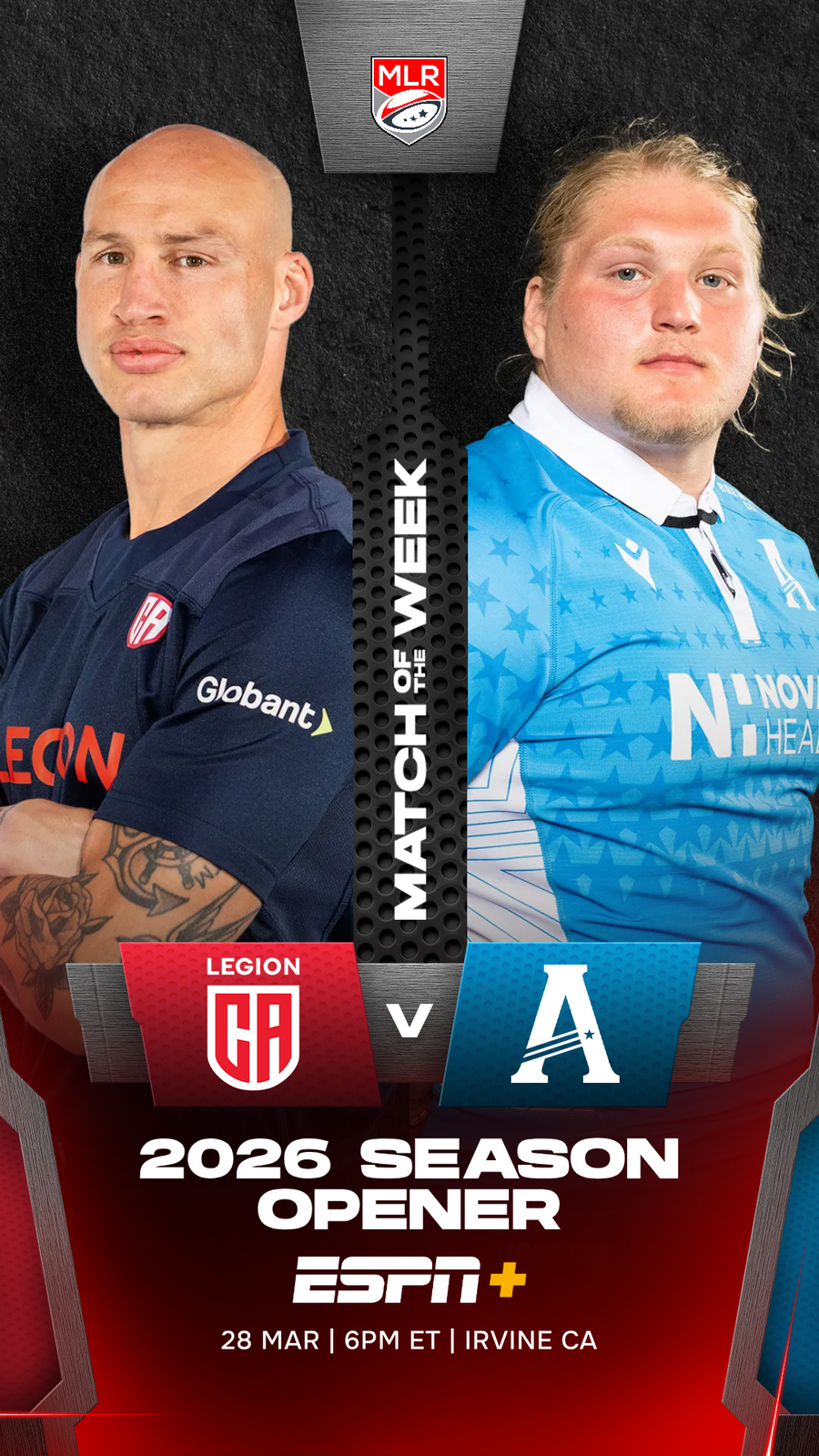
Billy Meakes does not make many speeches. The two-time Major League Rugby Back of the Year tends to let his playing tell most of the story. But returning to MLR for his first game of the 2026 season, the Australian centre offered the league's audience a short, characteristically unfussy summary of why he is still in the game at all.
"I mean, discipline for me is everything," Meakes said. "It's probably allowed me to have the rugby career that I've had. It's good for my body. It's good for my mind. And honestly, it's just good for my life."
It is a line that doubles as a thesis. Meakes' career has been defined less by raw flourish than by repeatable standards - a player coaches lean on because they know what they are getting from the moment he steps off the team bus. In a league still finding its rhythm year on year, that kind of week-to-week reliability is a competitive advantage in itself.

The MLR has spent the past several seasons in a constant state of self-reinvention. Franchise turnover, scheduling tweaks and a reshaped expansion picture have made the competition's narrative arc unpredictable - and made experienced players who can hold a midfield together even more valuable. Meakes, a back who has won Back of the Year honours twice, fits the profile a coach reaches for when the season's first month decides everything.
The 2026 campaign also reads as one of the more consequential MLR seasons to date. The league has spent the past two off-seasons recalibrating its squad caps, working through ownership transitions in several markets, and trying to bed down a more sustainable broadcast picture in an American sports landscape that does not give breathing space to leagues that lose narrative momentum. For long-tenured players like Meakes, this season is the one in which the league's adjustments either start to show on the field, or do not.
Discipline, in that context, is more than a personal value. It is the operating model the MLR is asking its veterans to demonstrate to a generation of younger American players who still see the league as an apprenticeship in professional rugby standards rather than the destination. Meakes' framing of it - body, mind, life - is the kind of full-stack definition the MLR's coaching staffs are leaning into when they talk about retention and culture.
The on-field part of his return will be assessed week by week. Meakes is not the kind of player who needs a try in his first appearance to settle the conversation about whether he is worth the slot - the league has watched him long enough to trust the trajectory. What this opening fixture does instead is restart a clock: the clock on what may be one of his last MLR seasons at the top of his powers, on a roster he can mould around him, in a league still defining what its peak years look like.

His final word - that discipline is "good for my life" - is the bit of the quote that will travel beyond rugby. It is the kind of off-field framing the MLR's marketing team has tried to amplify for years, the message that a league with a small but growing American audience can sell players as more than scoreline contributors. Meakes' delivery of it had no rehearsal in it; he has clearly believed the line for a long time.
The 2026 MLR season has its veteran returner. He is back on the field, the principles have not changed, and the quote was as concise as the playing style. For a player who has built a career on doing the same things to the same standard, that consistency is, as he says, everything.