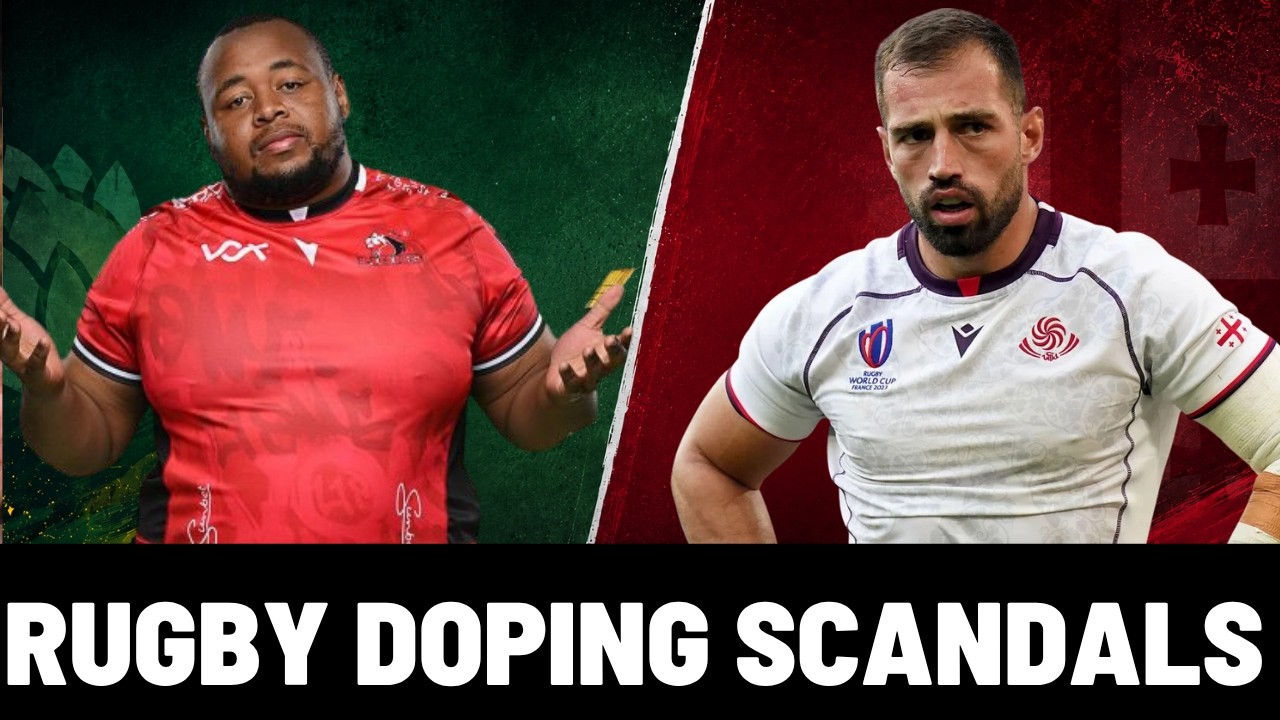
Eggchasers Rugby has dug into the two doping stories that landed on rugby this week and argued that, despite the matching headlines, the cases sitting on the disciplinary panel's desk could not be more different — one looking like a clean-faith mistake, the other a textbook conspiracy that may yet pull a national team out of the 2027 Rugby World Cup.
On one side of the Eggchasers comparison is Lions and Springbok prop Asenathi Ntlabakanye, the 27-year-old tighthead whose 18-month ban will run almost exactly to the day of the World Cup final. The host noted that Ntlabakanye tested positive for what he described as a hormone metabolic modulator in May 2025 and then DHEA in September — the latter a testosterone-boosting anabolic steroid — and that the defence has rested on the prop having been prescribed both substances by a medical professional.
"If he'd have continued with the form and development that he's been showing, he's been a rising star for the Boks and for the Lions," Eggchasers said. "I think he would have made that World Cup squad as a tighthead prop alongside Thomas du Toit and Wilco Louw, and that opportunity has been taken from him."
The wider sanctions extend beyond the playing ban. Eggchasers walked through the small print: forfeited match fees, bonuses and any individual awards earned during the relevant period would have to be handed back. "He's going to have his earnings taken away for the next 18 months, and then will he be able to get his rugby career back on the road after that?" the host asked. A three-week appeal window remains open, with the Lions, World Rugby and the South African Institute for Drug-Free Sport all able to lodge with the Court of Arbitration for Sport.
Eggchasers leaned into a phrase he uses repeatedly to frame the case: "Two things can be true at the same time." Ntlabakanye, in the host's view, deserves real sympathy if he genuinely trusted his medical adviser. But the rules cited by the South African Institute for Drug-Free Sport, the World Anti-Doping Agency and World Rugby all carry the same final test: "Players take responsibility for what they ingest and use, irrelevant of medical advice. So two things can be true at the same time. He could absolutely have put his faith in a medical expert, but he also has to take responsibility for what he takes."
The identity of the prescribing doctor has not been disclosed publicly, which Eggchasers said leaves an obvious follow-up question hanging — whether the practitioner involved was a Lions team doctor, a Springbok-attached medic or a private operator. "Will there be a case to answer for that doctor in the future? Possibly," the host said. "That process may well be waiting until the appeals process is done before that starts."
That contrasts sharply with the second story Eggchasers spent the back half of the episode on: the Georgian national team scandal that World Rugby has formally described as the sport's biggest ever doping case. Six Georgian players plus the team doctor have been banned, with sentences running from 11 years for the captain — who, according to the disciplinary findings, was not even the player taking the substances — down to nine years for the team doctor and a string of multi-year sanctions for the others, totalling some 35 years across the group.
The mechanism, as Eggchasers laid it out, was a coordinated cheating operation in the build-up to Rugby World Cup 2023: urine sample swapping, advance warnings about scheduled drug tests delivered through the team doctor on WhatsApp groups, and time bought to organise clean samples in place of compromised ones. The substances at the centre of it were, the host noted, recreational rather than performance-enhancing — but the deception is what World Rugby has hammered.
"It's deception, it's obstruction of testing, it's coordinated cheating," Eggchasers said. The host then warned that Georgia, a side many pundits had been pushing for Six Nations promotion, may now face an existential decision from World Rugby. "I'm not saying this will happen, but it could be the case that World Rugby say that this was so bad that the whole team gets banned from the 2027 Rugby World Cup."
Eggchasers closed with a warning about second-order effects in Tbilisi: the Georgian government has reportedly stepped back from rugby funding, switched the team to a smaller national venue, and tilted state focus back towards football. For a country still seen as the most credible challenger to the established tier-one bracket, the doping scandal may have cost more than just the players on the WhatsApp group.